
All-In with Chamath, Jason, Sacks & Friedberg - Inauguration Interviews: Trump's Talent, Democratic Rebrand & more with House Whip Emmer, Reps Swalwell & Khanna
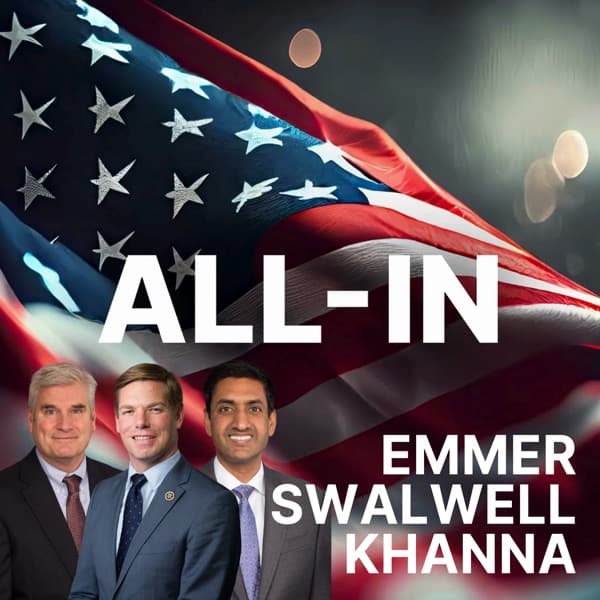
The conversation explores the political landscape following Donald Trump's re-election, highlighting the perceived failures of the Democratic Party and the role of media in shaping public perception. The discussion touches on fiscal responsibility, emphasizing the need for budget cuts and efficient government spending. Immigration policies are debated, with a focus on securing borders and addressing illegal immigration while considering economic impacts. The role of technology, particularly cryptocurrency and TikTok, is examined in terms of regulation and national security concerns. The dialogue underscores the need for bipartisan cooperation and pragmatic governance to address these complex issues.
Key Points:
- Political dynamics post-Trump's re-election highlight Democratic Party's challenges and media influence.
- Fiscal responsibility is emphasized, with calls for budget cuts and efficient government spending.
- Immigration debate focuses on securing borders, addressing illegal immigration, and economic impacts.
- Technology regulation, especially concerning cryptocurrency and TikTok, is discussed in terms of security.
- Bipartisan cooperation and pragmatic governance are needed to address complex national issues.
Details:
1. 🎙️ All-In Podcast Inauguration Special: Setting the Stage
- The podcast marks the inauguration special coinciding with Donald Trump's second term, setting a reflective and celebratory tone while acknowledging diverse political perspectives.
- Spotify is a key partner, providing support and resources for the podcast, including enhanced distribution and marketing capabilities, to expand its reach and influence.
2. 🎉 Co-hosts' Social Escapades and Political Tidbits
2.1. Glass Box Venue
2.2. Friedberg's Night Out
2.3. Shamath's Social and Political Engagements
3. 🎤 Tom Emmer Discusses Democratic Leadership and Media Bias
3.1. Critique of Democratic Leadership
3.2. Media Bias and Political Reporting
4. 💰 Navigating Fiscal Responsibility and Social Security
- The leadership within the Democratic Party is perceived by some as corrupt, with significant influence attributed to figures like the Obamas and Clintons, as well as superdelegates and super donors.
- There is skepticism about the decision-making process within the Democratic Party, particularly surrounding the 2020 election cycle, where there was a strategic shift towards Joe Biden's candidacy after South Carolina primaries.
- The role of influential consultants and donors in shaping the Democratic Party's leadership decisions is highlighted, with names like Carville, Axelrod, and Soros mentioned.
- The strategic shift in the 2020 election cycle, particularly the focus on Biden's candidacy, was influenced by key endorsements and financial support from powerful figures within the party, affecting the party's fiscal policies.
- The impact of donor influence extends to fiscal responsibility, as these donors often have vested interests in specific economic policies, which can shape the party's stance on social security and other fiscal matters.
5. 🛠️ Immigration Policies and Labor Market Dynamics
- The Republican party's process is described as bottom-up, highlighted by Donald Trump's rise, who garnered 77 million votes, surpassing the party's 75 million, illustrating his strong influence on the party's direction and policies.
- The Democratic party is perceived as operating top-down, facing internal challenges like identity politics and influential factions that may not represent the broader party base, impacting their approach to immigration policies.
- There's a call for Democratic party members to oppose divisive influences and reclaim traditional values, potentially affecting policy directions.
- These political dynamics within both parties directly influence their stances on immigration policies and labor market strategies, with the Republican party often advocating for stricter immigration controls, while the Democratic party may pursue more inclusive policies.
6. 🌐 Global Trade, TikTok, and Security Concerns
6.1. Political Identity and Resonance
6.2. Donald Trump's Political Influence and Leadership Skills
6.3. Fiscal Responsibility and Budget Concerns
7. 🔍 Governance, Economic Policies, and Party Challenges
- The federal budget is currently $7.2 trillion annually, with an emphasis on stopping the loss of $1.5 to $2.2 trillion each year to achieve a balanced budget.
- A key objective is to reduce the economic curve downward, aiming for improved economic performance, which is believed to be achievable under Donald Trump's leadership.
- The reconciliation process is aimed at ensuring a budget resolution vote by the first week of February, with a subsequent House vote planned for early April.
- This process includes making certain tax cuts from the 2017 Trump tax cuts permanent, with a completion target set for March.
- There's a strategic focus on fiscal responsibility and tax policy adjustments to foster long-term economic stability.
8. 📊 Economic Vision and Technological Innovation
- By 2030-2033, Social Security may require innovation and honoring existing promises, with discussions on voluntary private alternatives for new entrants akin to Australia's system.
- Politicians often avoid discussing Social Security reform due to electoral concerns, but building credibility with the public through economic performance may open up the conversation.
- Reforms focusing on efficiency could enhance Social Security, Medicare, and Medicaid's financial viability without cutting benefits.
- The debate on cryptocurrency regulation reflects a tension between libertarian ideals and a Republican perspective valuing the U.S.'s strong financial system.
9. 🇺🇸 Immigration, Patriotism, and American Identity
- Congress needs to establish clear market structures and rules for crypto to protect the existing financial system and safely transition it to modern standards.
- Central bankers are concerned about the disruptive potential of cryptocurrency and its impact on financial power structures.
- There is a risk that unsophisticated consumers may lose money in the crypto market, highlighting the need for regulatory oversight.
- Former President Trump launched a $30 billion coin referred to as a 'meme coin,' raising questions about the wisdom and implications of such actions.
- The role of the SEC is evolving, with potential changes in how it regulates cryptocurrencies and retail investor protections.
- There is an ongoing debate about the accessibility of cryptocurrencies for retail investors and the need for a sophisticated investor test to educate potential investors about risks such as coin ownership concentration and selling conditions.
10. 🌿 Environmental Policies, Wildfires, and Governance
- 55% of Americans support the deportation of any illegal immigrant, indicating significant public opinion on immigration policy.
- A historically low 4% unemployment rate juxtaposed with a tripling of agricultural labor costs over 4-5 years suggests a critical labor shortage.
- The need for reform in the immigration system is emphasized to balance economic labor demand and immigration challenges.
- Efforts should focus on legal immigration system improvements to address labor shortages, rather than relying on illegal immigration.
- Minnesota's economy, reliant on manufacturing and agriculture, highlights the urgency of addressing these labor shortages.
11. 🔄 Democratic Party's Future: Leadership and Strategy
- The House passed a significant border security bill with bipartisan support from 222 members, focusing on completing the border wall, reforming the parole and asylum processes, ending catch and release, and reinstating the 'remain in Mexico' policy.
- Despite its passage in the House, the bill was not taken up by Senate Majority Leader Chuck Schumer, highlighting a strategic divergence between the House and Senate Democrats.
- The legislation addresses key concerns about illegal immigration, emphasizing the removal of criminals who commit crimes while in the country illegally.
- There is an ongoing debate within the Democratic Party on the feasibility and ethics of removing approximately 14.5 million undocumented individuals.
- This issue of whether to remove 15 million undocumented individuals presents a significant strategic challenge for Democrats, impacting their policy and electoral strategies.